Category: Home and Lifestyle

  • Your Brain Is Being Dramatic Again: A Reminder for Overthinkers

    Your Brain Is Being Dramatic Again: A Reminder for Overthinkers


    You know that thing you said three days ago?

    The one you’ve replayed approximately 47 times, analyzing your tone, their facial expression, what you should have said, and whether they now secretly think you’re weird They probably don’t. Your brain is just being dramatic again.
    Overthinking has a way of making very small things feel enormous. A delayed reply becomes “Did I do something wrong?” A strange tone becomes “They’re upset with me.” One mistake becomes “I always mess everything up.” And a completely unknown future somehow becomes a collection of very detailed disasters that haven’t actually happened.

    The funny thing is, we often know we’re doing it. We know we’re overthinking. And yet our brains respond with: Okay, but what if we think about it one more time? Maybe this time we’ll finally solve it.

    This post contains Amazon affiliate links. As an Amazon Associate, I earn from qualifying purchases, at no additional cost to you.


    For when your brain needs a little help switching off


    Sometimes I need a reminder that I don’t have to believe, analyze or solve every single thought that enters my head.

    So I put together a little collection of books and tools for overthinkers – books about quieting mental chatter and changing the way we relate to our thoughts, along with journals and simple screen-free activities for those moments when you just need to get out of your own head.
    → [For When Your Brain Is Being Dramatic – Books & Tools for Overthinkers]

    Among the books I’ve included are titles about overthinking, worry and that endlessly chatty inner voice, plus a few simple things for journaling, slowing down and redirecting your attention when your thoughts are going in circles. Now, back to that brain of ours.


    Not Every Thought Deserves Your Attention


    This might be one of the most important things to remember when you tend to overthink: Having a thought doesn’t make it true. It doesn’t even necessarily make it important. Sometimes our thoughts are useful. They help us solve problems, notice when something isn’t right and make decisions. Other times? Our brains take one tiny piece of information and write an entire screenplay around it.
    Reality: They haven’t replied yet.
    Brain: They’re annoyed with me. I said something wrong. They’re deliberately ignoring me. Was it that thing I said yesterday? I knew I shouldn’t have said that.

    But the only thing we actually know is: They haven’t replied yet. Everything else is a story we’ve created to fill in the information we don’t have. And once you start noticing the difference between what happened and what your brain says it means, some of those thoughts become a lot less convincing.


    You Don’t Have to Figure Everything Out Right Now


    I think a lot of overthinking comes from wanting certainty. We want to know we’re making the right decision. We want to know whether something will work out. Whether someone likes us. Whether we’re wasting our time. Whether we’ll succeed. Whether everything is going to be okay. So we think. And think. And think some more. As though somewhere around thought number 183, absolute certainty is finally going to appear. But some things simply can’t be known yet. Sometimes the answer only comes from living long enough to find out. There is something strangely freeing about admitting: I don’t know. I don’t know exactly what will happen. I don’t know what someone else is thinking. I don’t know whether every decision I make will turn out to be the right one. And I don’t need to know everything today.


    Ask Yourself: Is This Actually Happening?


    When your brain starts running away with a situation, try separating what you know from what you’re imagining.

    Ask yourself: What is actually happening right now? Not what might happen tomorrow. Not what you’re afraid this could mean. Not what happened once five years ago and your brain has suddenly decided is extremely relevant.

    What is happening right now? Sometimes the answer is almost funny. You’re sitting on the couch. You’re drinking coffee. The sun is coming through the window. Your phone is sitting beside you. Everything is completely fine.
    Meanwhile, somewhere inside your head: EMERGENCY MEETING.
    Your brain has created a crisis that currently exists almost entirely in your imagination. Coming back to what is physically happening around you can make the story in your head feel a little smaller.


    What If You Let the Thought Be Unfinished?


    This one is difficult for overthinkers.

    We like conclusions. We want to understand why. Why did they say that? Why did that happen? What does it mean? What should I do? What if I misunderstood? What if I make the wrong decision?
    We keep turning the thought over because it feels uncomfortable to leave a question unanswered. But not every thought needs a satisfying conclusion. Sometimes you can simply say: I don’t know. Maybe I’ll understand later. There isn’t anything I need to do about this right now.
    And then go make dinner.
    There is something wonderfully rebellious about declining the emergency meeting your brain has scheduled.


    Give Yourself a Reality Check


    When you catch yourself spiraling, it can help to ask a few simple questions:

    What do I actually know?
    What am I assuming?
    Is there anything I can realistically do about this right now?
    Will thinking about this for another hour actually change anything?
    Am I solving a problem, or am I just repeating it?

    That last one is especially important. Because thinking about something and solving something aren’t necessarily the same thing. Sometimes we’re not getting any closer to an answer. We’re just walking around the same mental roundabout.


    Get Out of Your Head and Into Your Life


    Sometimes the best response to overthinking isn’t another thought.

    It’s doing something.
    Go for a walk.
    Take a shower.
    Read ten pages of a book.
    Make something with your hands.
    Do a puzzle.
    Clean one drawer.
    Write everything down and close the notebook.
    Put on music.
    Go outside.
    Call someone.
    Take photographs.

    Make something terrible just because making it is fun. Do something that reminds you there is an entire world happening outside your thoughts. You don’t always need to think yourself out of overthinking. Sometimes you need to stop thinking for a while and go live.


    Your Brain Isn’t Always the Best Storyteller


    Our brains are incredibly good at filling in blanks. Unfortunately, they don’t always choose the nicest explanation.

    Someone is quiet? – They’re angry.
    Something feels uncertain? – It’s going to go badly.
    You made a mistake? – Everyone noticed.
    Something good is happening? – Okay, but what if it goes wrong?

    Thanks, brain. Very helpful.

    But you don’t have to follow every story all the way to the ending. You can notice the thought without turning it into a prediction. You can feel uncertain without immediately trying to eliminate the uncertainty. You can have an awkward moment without making it part of your identity. You can make a mistake without deciding it says something terrible about you. And you can have a worrying thought without treating it like a warning from the future.


    You Are Probably Thinking About Yourself More Than Anyone Else Is


    Remember that embarrassing thing you did five years ago? Probably. Now try to remember five embarrassing things other people did five years ago. Exactly.

    We spend so much time worrying about how we’re being perceived while everyone else is busy doing the same thing about themselves. Most people aren’t analyzing your awkward sentence. They’re thinking about their own awkward sentence. They’re not lying in bed conducting a detailed investigation into the weird thing you did at dinner. They’re wondering whether they were weird at dinner. There is something incredibly freeing about realizing that you are simply not the main character in everyone else’s head.


    And What If It Actually Goes Wrong?


    This might be my favorite question. Because overthinking often tries to protect us by predicting every possible negative outcome. But let’s say one of them actually happens. You make the wrong decision.
    Someone doesn’t like you.
    Something doesn’t work out.
    You embarrass yourself.
    Plans change.
    You fail at something.
    Then what?
    You’ll deal with it.
    You’ll learn something.
    You’ll change direction.
    You’ll be embarrassed for a while and eventually laugh about it.
    You’ll make another decision.
    You’ll keep going.
    You don’t need to mentally experience every possible disaster in advance just to prove that you’ll be capable of handling life when it happens.


    Maybe It Really Isn’t That Deep


    Of course, some things are worth thinking deeply about. Important decisions deserve consideration. Difficult feelings shouldn’t simply be pushed away. Sometimes worry is pointing toward a real problem that needs our attention. But not everything requires that level of analysis. Not every awkward interaction needs a post-mortem. Not every unanswered message means something. Not every mistake reveals something profound about who you are. Not every uncertain situation needs to be solved tonight. Not every thought deserves another thought. Sometimes the conversation was just a conversation. The look was just a look. The silence was just silence. And the thing you’ve been analyzing for the last hour? Maybe it really isn’t that deep. Sometimes your brain is simply being dramatic again. Let it have its moment.
    Then go live your life.


  • Dream On: Why We Should Never Stop Imagining What Could Be

    Dream On: Why We Should Never Stop Imagining What Could Be


    When we’re children, dreaming comes naturally.

    We imagine places we’ll visit, lives we’ll live, things we’ll create and people we’ll become. We don’t immediately ask whether those dreams are realistic, productive or sensible.

    We just imagine.

    Somewhere along the way, that changes.

    Adulthood has a way of filling our minds with practical things. Work. Money. Responsibilities. Appointments. Plans for next week. Things that need fixing. Things that need finishing.

    Without really noticing, What if? slowly becomes What’s realistic?

    And maybe we need a little more of the first one.


    The Inspiration Behind “Dream On”


    Recently, I’ve been experimenting with magazine collage art – cutting apart old magazines and turning completely unrelated images into something new.

    There is something wonderfully unpredictable about it.

    You don’t begin with an endless library of perfectly coordinated images. You have whatever happens to be printed on those pages.

    You search.

    You notice things you would normally flip past.

    You find a photograph that makes you feel something, even if you can’t quite explain why. You cut it out and save it.

    Eventually, little fragments that had absolutely nothing to do with each other begin to tell a story.

    For this collage, I wanted that story to be about dreaming.

    Not necessarily the enormous, life-changing kind of dreams.

    Just the ability to imagine that life could still surprise us.


    When Did We Become So Practical?


    There is nothing wrong with being realistic. We need plans, responsibilities and some idea of where we’re going.

    But I don’t think realism and dreaming have to cancel each other out.

    You can appreciate the life you have while imagining something different.

    You can be grateful and still want more.

    You can have absolutely no idea how something will happen and still allow yourself to wonder what it would feel like if it did.

    Not every dream needs to become a goal.

    Not every idea needs a five-step plan.

    And not everything we imagine needs to be useful.

    Sometimes dreaming is simply giving our minds somewhere beautiful to wander.


    Creativity Gives Us Permission to Imagine Again


    Maybe that’s part of why I’ve been enjoying creative hobbies so much.

    When you’re making something, there isn’t always a correct answer.

    You can move something because it doesn’t feel right.

    You can choose one colour over another simply because you like it.

    You can change your mind halfway through.

    You can make something strange.

    You can make something beautiful.

    You can make something that nobody else completely understands.

    And none of it needs to accomplish anything.

    There is something incredibly freeing about that.

    In a world where so much of our time is measured by what we accomplish, creating something simply because we wanted to feels almost rebellious.


    Dream On


    That’s why I chose these two little words for this collage.

    Dream On.

    They’re not instructions to quit your job, move across the world or chase some enormous life transformation. They’re much smaller than that. Keep imagining. Keep being curious about what your life could contain. Make the strange thing. Try the hobby you’ve been thinking about. Visit somewhere new. Pick up the book. Take the photograph. Start something even when you’re not particularly good at it yet. And leave a little room in your life for ideas that don’t make perfect sense. Because sometimes the things we dismiss as daydreams are simply possibilities we haven’t figured out yet. And sometimes dreaming doesn’t need to lead anywhere at all. Sometimes it’s enough that, for a moment, it makes the world feel a little bigger.

    Dream on.


  • Finding Magic in Old Magazines

    Finding Magic in Old Magazines


    There was something strangely satisfying about sitting on the floor with a stack of old magazines, a pair of scissors, and no real plan.

    No notifications.
    No deadlines.
    No perfect outcome to chase.

    Just page after page of forgotten photographs, illustrations, flowers, faces, strange objects, and tiny pieces waiting to become something new.

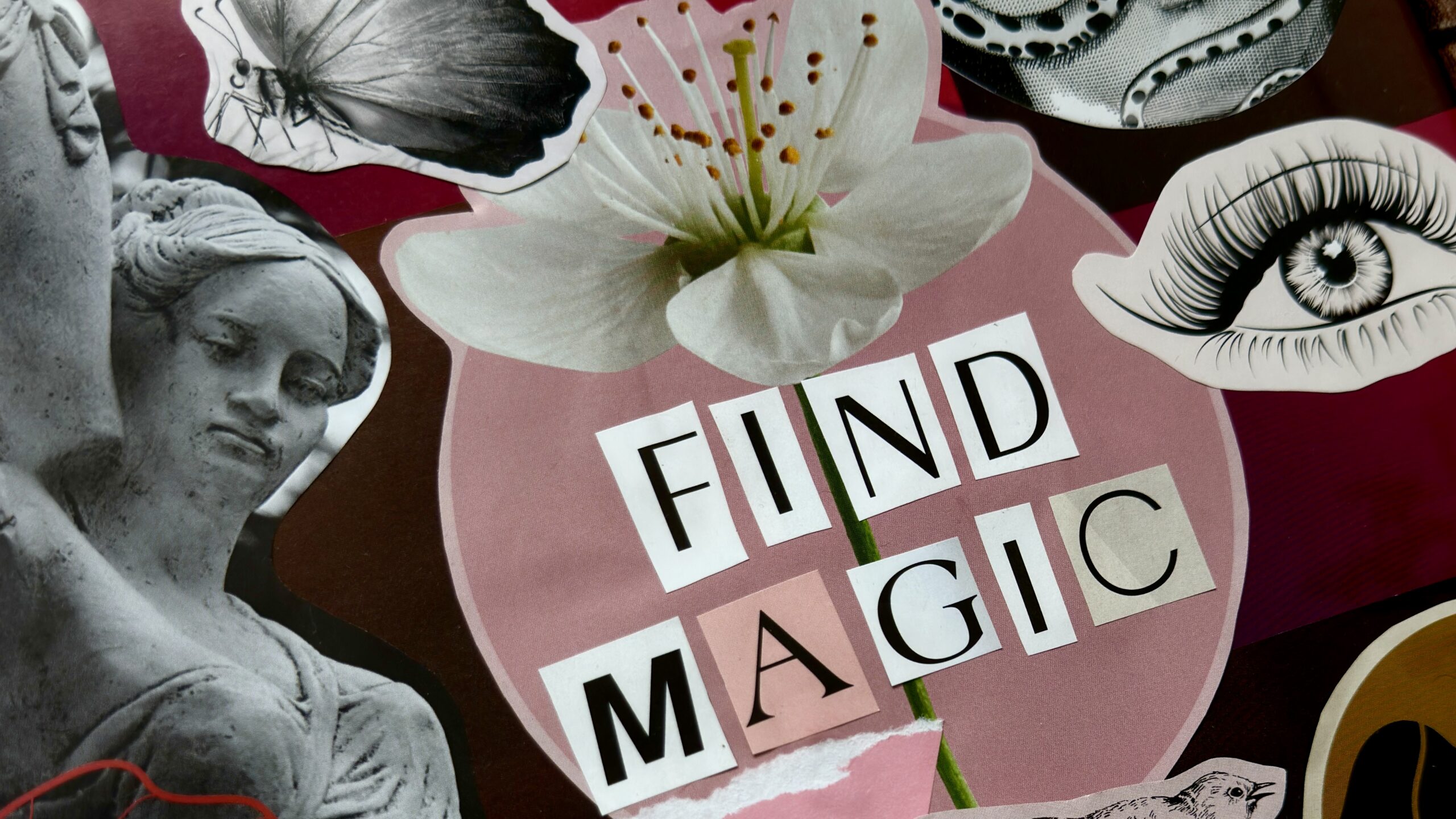
    I started cutting out anything that caught my attention. A butterfly. A flower with an eye at its center. A classical statue. A simple line drawing. None of them made sense on their own, but somehow they began to belong together.

    Somewhere in the middle of arranging everything, I found the words “find Magic”.

    It wasn’t the phrase I had planned from the beginning. In fact, I wasn’t sure there would be a message at all. But once those two words appeared, the whole collage suddenly felt complete.

    Maybe that’s what creativity is.

    Not forcing an idea to happen, but giving it enough room to reveal itself.


    Creating Without a Goal


    So much of our everyday life revolves around productivity.

    We often ask ourselves whether a hobby is useful, whether we’re good at it, or whether the final result will be worth sharing.

    This collage reminded me that creating something simply because it feels enjoyable is reason enough.

    There were no rules.

    Some pieces stayed.
    Others were removed.

    I rearranged everything several times before I found a composition that felt balanced. There wasn’t a “correct” version – only the one that felt right to me.

    That freedom was surprisingly refreshing.


    Beauty in Forgotten Things


    One of my favorite parts of this project was using magazines that might otherwise have ended up in recycling.

    A single page that no longer had value on its own became part of something completely different.

    It’s a small reminder that beautiful things don’t always have to begin with brand-new supplies.

    Sometimes all they need is a different perspective.


    Why I Think Everyone Should Try It


    You don’t need to be artistic.

    You don’t need expensive materials.

    All you really need is:

    • A few old magazines
    • Scissors
    • Glue
    • A frame or sturdy piece of paper
    • An afternoon with nowhere else to be

    The best part isn’t finishing the collage.

    It’s getting completely absorbed in the process of searching, arranging, moving things around, and slowly watching a collection of unrelated pieces become something meaningful.

    For a little while, the rest of the world becomes quieter.


    Find Magic


    Looking at the finished collage now, I realize the phrase in the center isn’t really about the artwork.

    It’s a reminder.

    Magic isn’t always something extraordinary.

    Sometimes it’s hidden inside an old magazine that someone was ready to throw away.

    Sometimes it’s found in an afternoon spent creating instead of scrolling.

    And sometimes it’s simply allowing yourself to make something imperfect – just because it makes you happy.

    If you’ve never tried magazine collage before, I hope this inspires you to give it a chance.

    You might discover that you’re creating more than wall art.

    You might just find a little magic, too.


  • 10 Cozy Board Games for Relaxing Nights at Home

    10 Cozy Board Games for Relaxing Nights at Home


    Some evenings don’t need a packed schedule or a reason to go out. Sometimes, all you need is a warm drink, good company, and a board game that brings everyone around the same table.

    I’ve always loved how board games slow life down. They encourage conversation, laughter, a little friendly competition, and hours away from screens. Whether you’re planning a date night, a family gathering, or a quiet evening with friends, these are some of my favorite cozy games worth checking out.

    This post contains affiliate links. As an Amazon Associate, I may earn a small commission if you make a purchase through these links, at no extra cost to you. Thank you for supporting HorizonLume!

    Scrabble

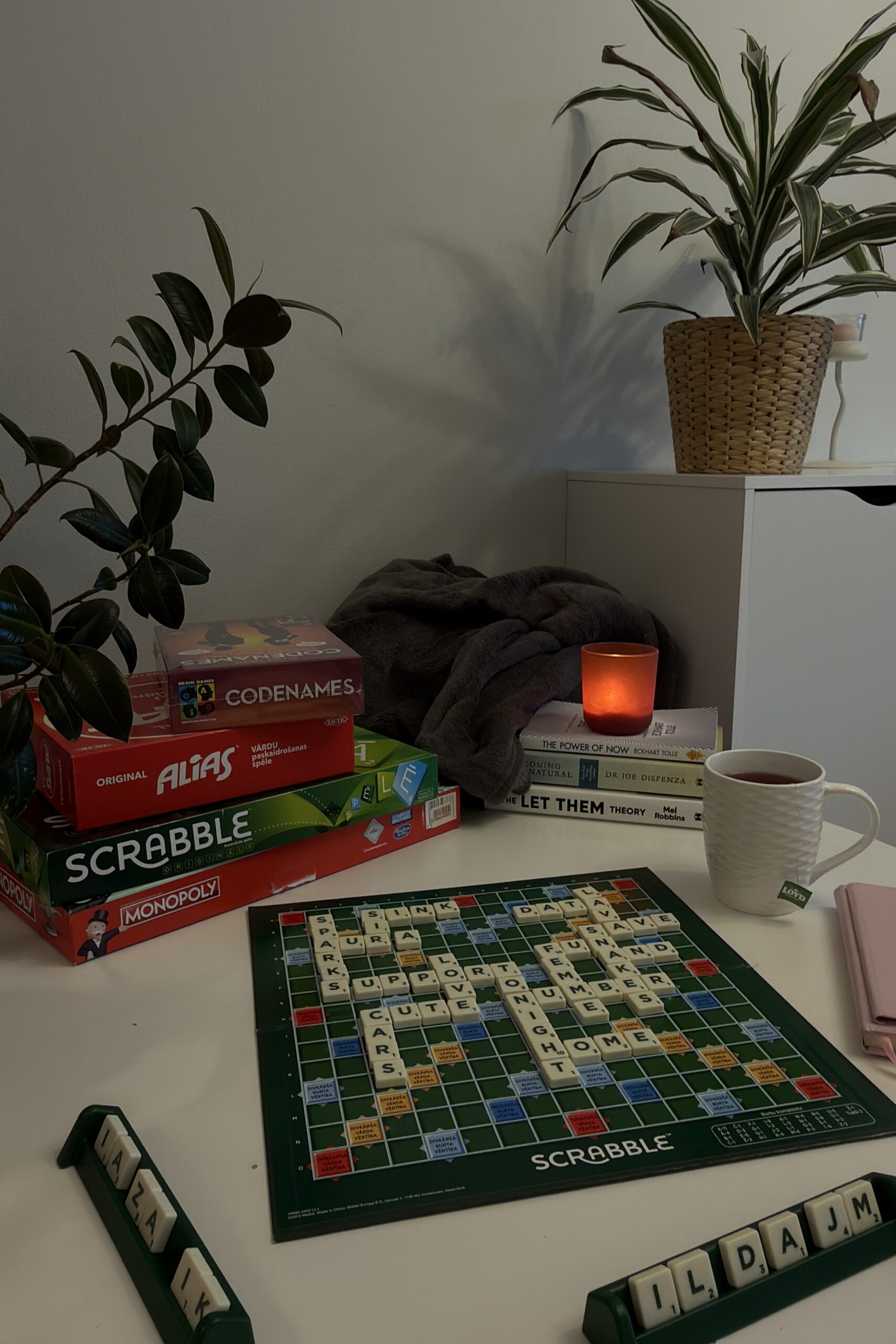
    If I had to choose just one game to keep forever, it would probably be Scrabble. There’s something timeless about sitting around a table, thinking of words, laughing over unusual spellings, and celebrating that one perfect high-scoring move.

    It’s one of those games that never feels outdated and somehow makes every evening feel a little cozier.

    Perfect for: Couples, families, and anyone who enjoys word games.

    👉 View on my Amazon Cozy Board Games list


    Ticket to Ride

    Ticket to Ride is one of those games that’s incredibly easy to learn but still exciting every time you play. Building railway routes across beautiful maps makes it feel more relaxing than competitive.

    It’s a great introduction if you’re just getting into modern board games.

    Perfect for: Beginners and family game nights.

    👉 View on my Amazon Cozy Board Games list


    Azul

    Azul is as beautiful as it is enjoyable. Every tile feels like a little piece of art, and creating colorful patterns is surprisingly calming.

    If you appreciate games that look as lovely on the table as they are to play, Azul is an easy recommendation.

    Perfect for: Quiet evenings and people who love beautiful design.

    👉 View on my Amazon Cozy Board Games list


    Wingspan

    Few games capture the peaceful feeling of nature as well as Wingspan. You’ll discover different bird species while building your own wildlife preserve, all illustrated with stunning artwork.

    As someone who loves spending time outdoors, this game feels especially fitting.

    Perfect for: Nature lovers and relaxing weekends.

    👉 View on my Amazon Cozy Board Games list


    Cascadia

    Cascadia combines forests, rivers, mountains, and wildlife into one beautifully designed strategy game. Every decision feels calm rather than stressful, making it perfect for slow evenings.

    It’s one of those games where simply looking at the finished board is satisfying.

    Perfect for: Anyone who loves nature-themed games.

    👉 View on my Amazon Cozy Board Games list


    Carcassonne

    Watching the countryside slowly come together tile by tile is oddly relaxing. Roads, castles, and fields grow into a unique landscape every single game.

    Despite its simple rules, it stays interesting for years.

    Perfect for: Couples and casual strategy fans.

    👉 View on my Amazon Cozy Board Games list


    Dixit

    Dixit is unlike almost any other board game. Instead of focusing on winning through strategy alone, it encourages creativity and imagination.

    The artwork is absolutely breathtaking, making every card feel like a tiny story waiting to be told.

    Perfect for: Creative people and larger groups.

    👉 View on my Amazon Cozy Board Games list


    Patchwork

    Patchwork proves that a two-player game doesn’t have to be complicated to be enjoyable. Building your quilt while trying to use every piece efficiently is surprisingly satisfying.

    It’s one of my favorite recommendations for cozy date nights.

    Perfect for: Couples.

    👉 View on my Amazon Cozy Board Games list


    Bananagrams

    Sometimes you want something quick, fun, and easy to bring anywhere. That’s exactly what Bananagrams offers.

    No board, no complicated setup—just fast-paced word building and lots of laughs.

    Perfect for: Travel, family gatherings, and spontaneous game nights.

    👉 View on my Amazon Cozy Board Games list


    Codenames

    Codenames turns simple words into an entertaining guessing game where teamwork matters more than luck.

    Every round creates funny misunderstandings and memorable moments, making it one of those games people ask to play again immediately.

    Perfect for: Friends and parties.

    👉 View on my Amazon Cozy Board Games list


    My Final Thoughts

    There is something wonderfully comforting about putting your phones away for a while and gathering around a table. Whether you’re playing a classic like Scrabble or discovering something new like Cascadia or Wingspan, board games have a way of bringing people together in a world that often feels too busy.

    If you’re looking to build your own collection, I’ve gathered all of these games (and a few extra favorites) in my Amazon Cozy Board Games Idea List, so you can explore them in one place.

    I hope this list inspires your next cozy evening at home. Happy gaming! 🌿